
Different Invoice Types in GST Billing: A Complete Guide for Indian Businesses
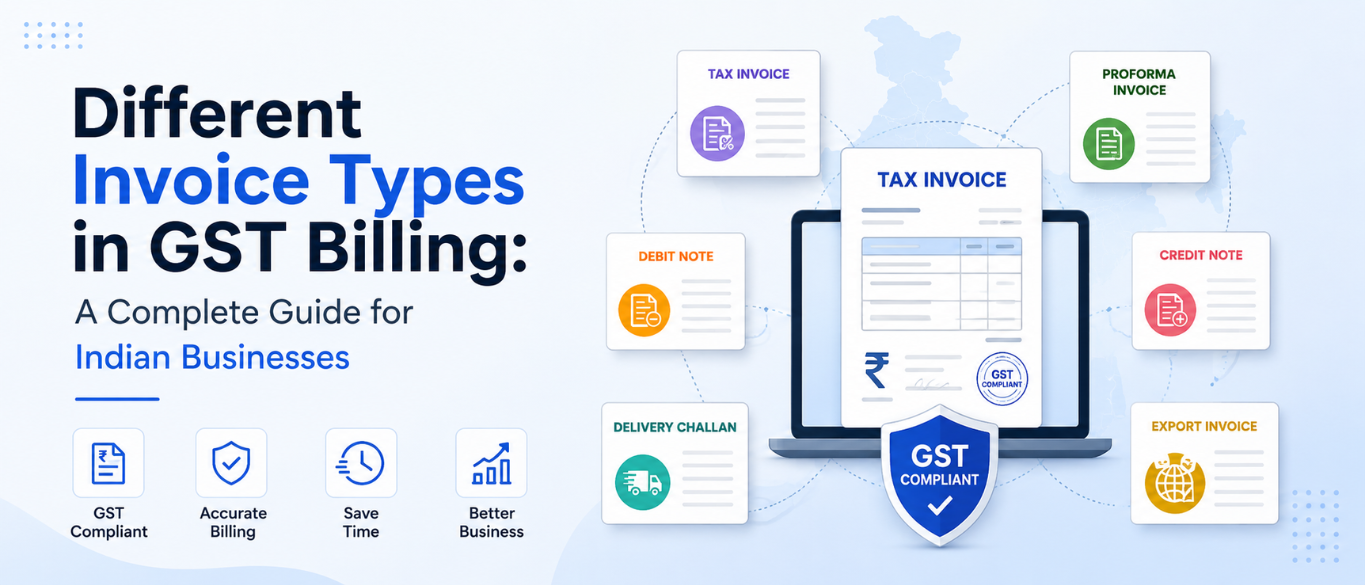
Different Invoice Types in GST Billing: A Complete Guide for Indian Businesses
For any business in India, invoices are not merely an instrument for requesting payments. Under the Goods & Services Tax regime, invoices are official documents used for recording the transfer of goods or services, determining the tax burden, and facilitating compliance when undergoing audit or while filing returns.
Most businesses make the mistake of assuming that only a single type of invoice can be used for all transactions. Under GST, invoices differ according to the kind of transaction, taxes applicable, corrections, or particular circumstances pertaining to the business.
Knowledge about the types of invoice under GST will enable your business to avoid filing mistakes, delayed payments, and non-compliance warnings. If you are a manufacturer, trading company, consultancy, or service provider, it becomes essential for you to know what kind of invoice you need.
This article discusses in detail the types of invoices that a GST business needs to understand.
Why Invoice Classification Matters Under GST
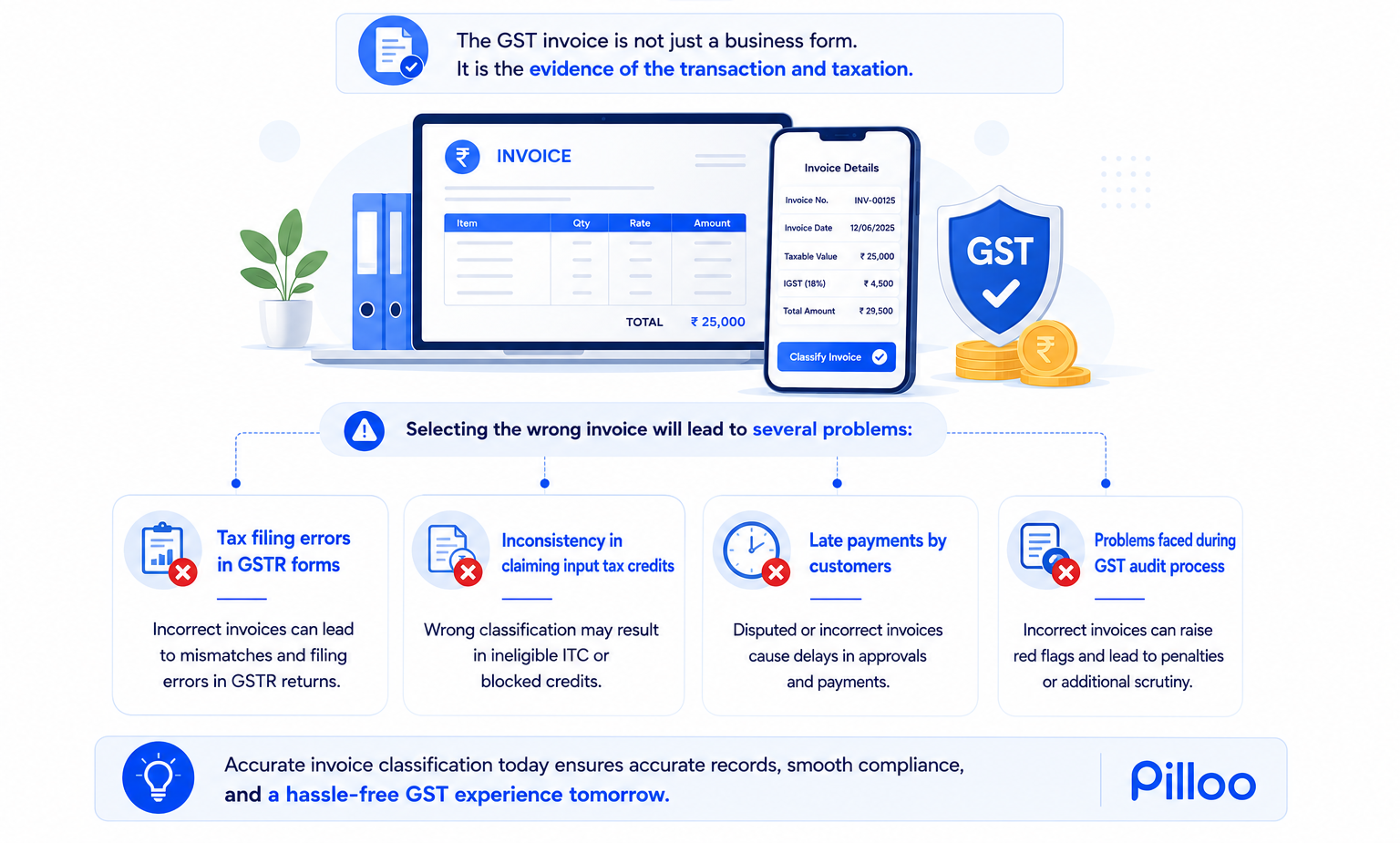
The GST invoice is not just a business form. It is the evidence of the transaction and taxation.
Selecting the wrong invoice will lead to several problems:
Tax filing errors in GSTR forms
Inconsistency in claiming input tax credits
Late payments by customers because of disputed invoices
Problems faced during GST audit process
Check out our Free GST Number Search & Verification Tool
This is why businesses need to have knowledge about various types of invoices that can be generated for GST transactions and the time when they should issue such invoices.
Types of Invoice in GST Billing
Tax Invoice
The tax invoice is one of the most frequently used invoices by registered GST companies. This invoice is issued when taxable goods or services are supplied.
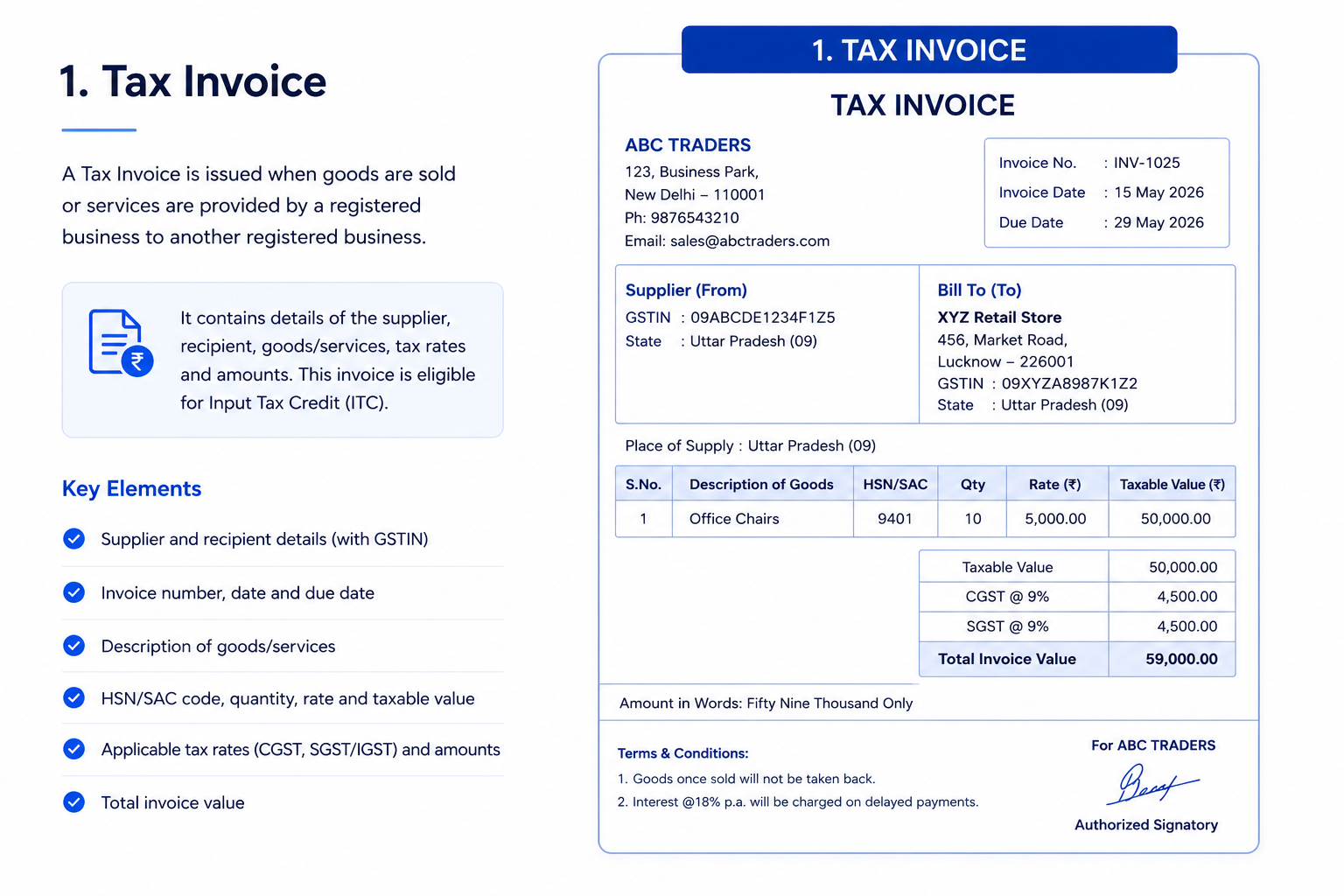
The tax invoice contains:
Name and address of the supplier and recipient
GSTIN number of the supplier and recipient (if applicable)
Invoice number and date
Details of goods or services supplied
Taxable amount
CGST/SGST/IGST information
If a producer supplies goods to a wholesaler, then in this case, a tax invoice should be issued.
Even now, the tax invoice bill book is prevalent among many companies. Even though digital invoices have gained popularity, the tax invoice book is still relevant for many Indian businesses.
When is a tax invoice needed?
It is necessary to issue a tax invoice when:
Taxable goods are supplied
Taxable services are supplied
GST is imposed on the business transaction
Bill of Supply
Bill of Supply is provided instead of a tax invoice when there is no GST levied on the transaction.
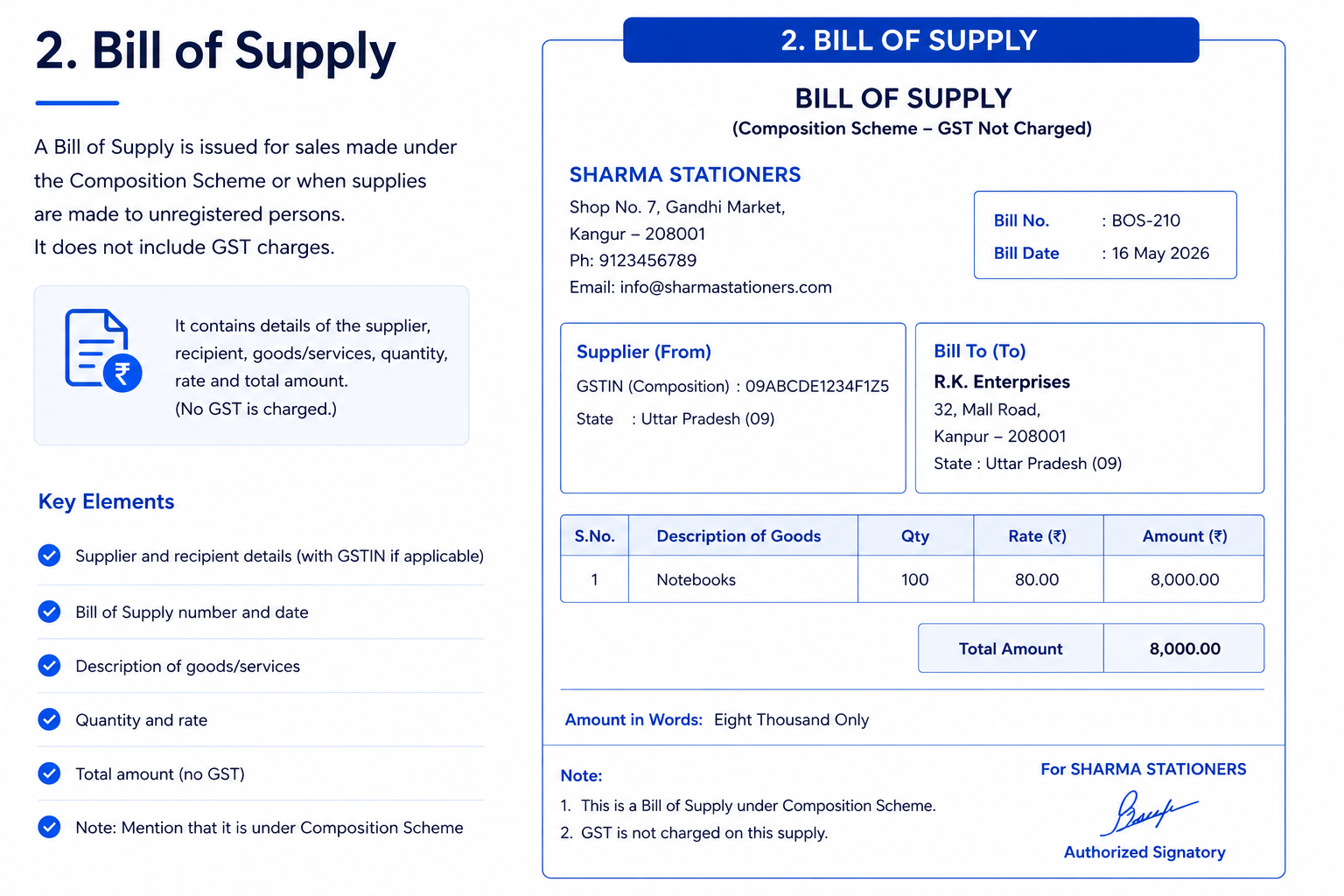
It applies mainly in cases of:
Registration of business under composition scheme
Supplier who deals with only exempt goods/services
As opposed to tax invoices, bills of supply do not carry any GST details, as there is no tax payable in the transaction by the supplier.
For example,
A composition dealer selling some stationery items will issue a bill of supply since he cannot issue a tax invoice for the sale of his items. This is another type of invoice that businesses often mix up with tax invoices.
Debit Note
When there is a need to increase the taxable value or GST amount in a transaction, a debit note will be issued.
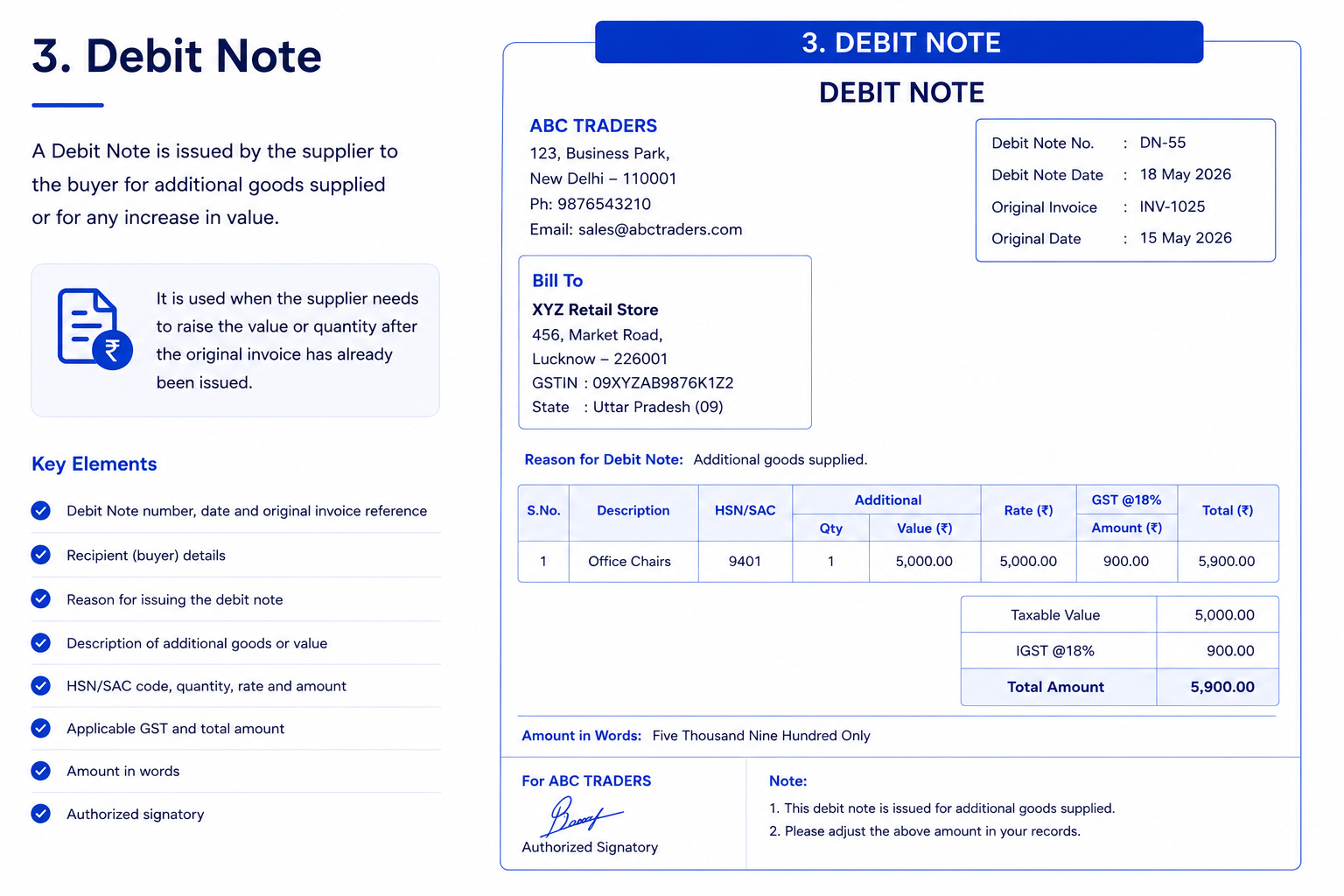
Cases requiring issuance of debit note
Increase in quantity of goods supplied
Revision of price after billing
Undercharge of tax in original invoice
Example
An invoice shows supplies worth ₹50,000; however, there was an error in that ₹5,000 worth of goods were left out. In this case, a debit note can be used to adjust the excess.
Credit Note
The credit note is opposite to the debit note. It is used when the supply value or tax charged must be reduced.
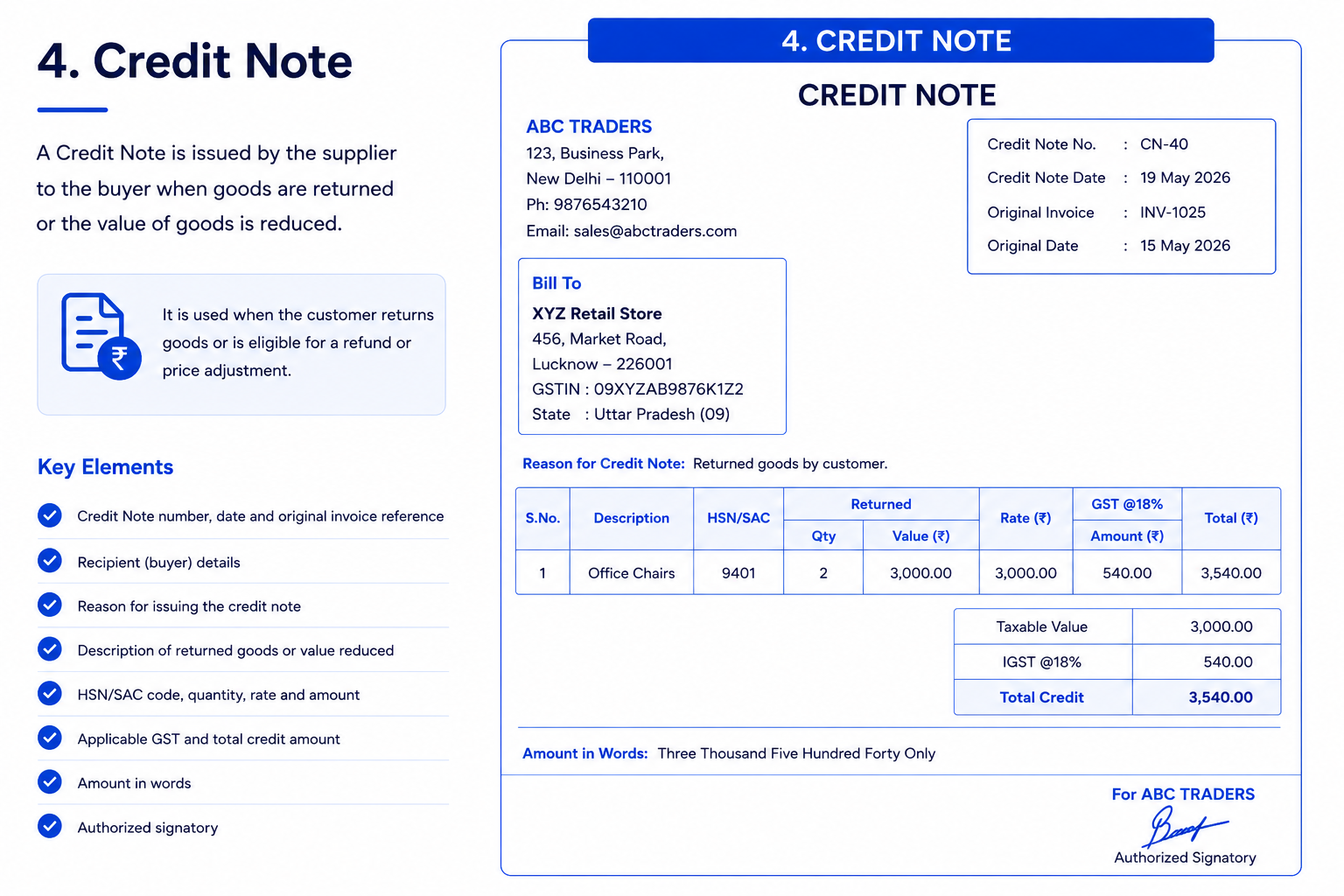
Cases where credit notes are issued include
Return of goods by customers
Post-invoicing discounts
Over-invoiced amount in initial invoice
Damages on delivered products
Example
The customer sends back some portion of the order once the products have been delivered. This might call for the use of a credit note to reduce the taxable amount.
Credit notes play a very crucial role in GST compliance since they affect tax liability directly.
Supplementary Invoice
Most people wonder what the supplementary invoice meaning is within the context of GST.
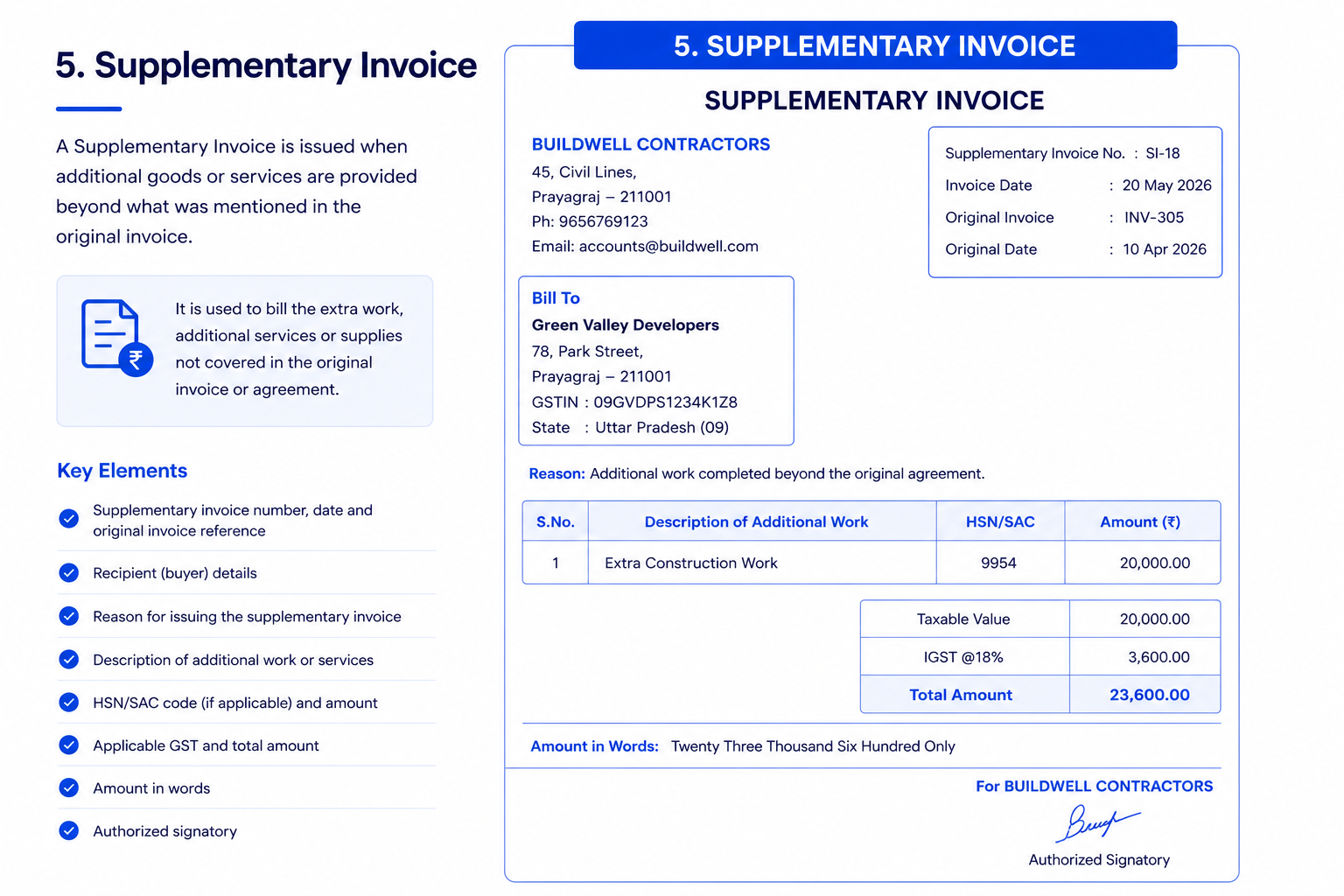
The supplementary invoice is issued whenever there is a need for an additional invoice after the initial one has been issued.
Supplementary invoice meaning an invoice issued in regard to the additional charges made on the initial supply.
Instances where a supplementary invoice is issued
Increase in price after the initial invoice
Extra work done beyond what was stated initially
Amendment in contract leading to additional expenses
Example
A contractor completes a project and later receives approval for extra work performed outside the original agreement. The additional amount may be billed through a supplementary invoice.
Businesses often confuse supplementary invoices with debit notes. Although both may increase the payable amount, the context of use can differ depending on business documentation practices.
Understanding the supplementary invoice meaning is particularly useful for service providers, contractors, and project-based businesses.
Revised Invoice
The revised invoice is an invoice that needs to be issued if a business decides to become registered for GST and wants to replace invoices raised between the date of becoming GST-registered and the actual receipt of the certificate of GST registration.
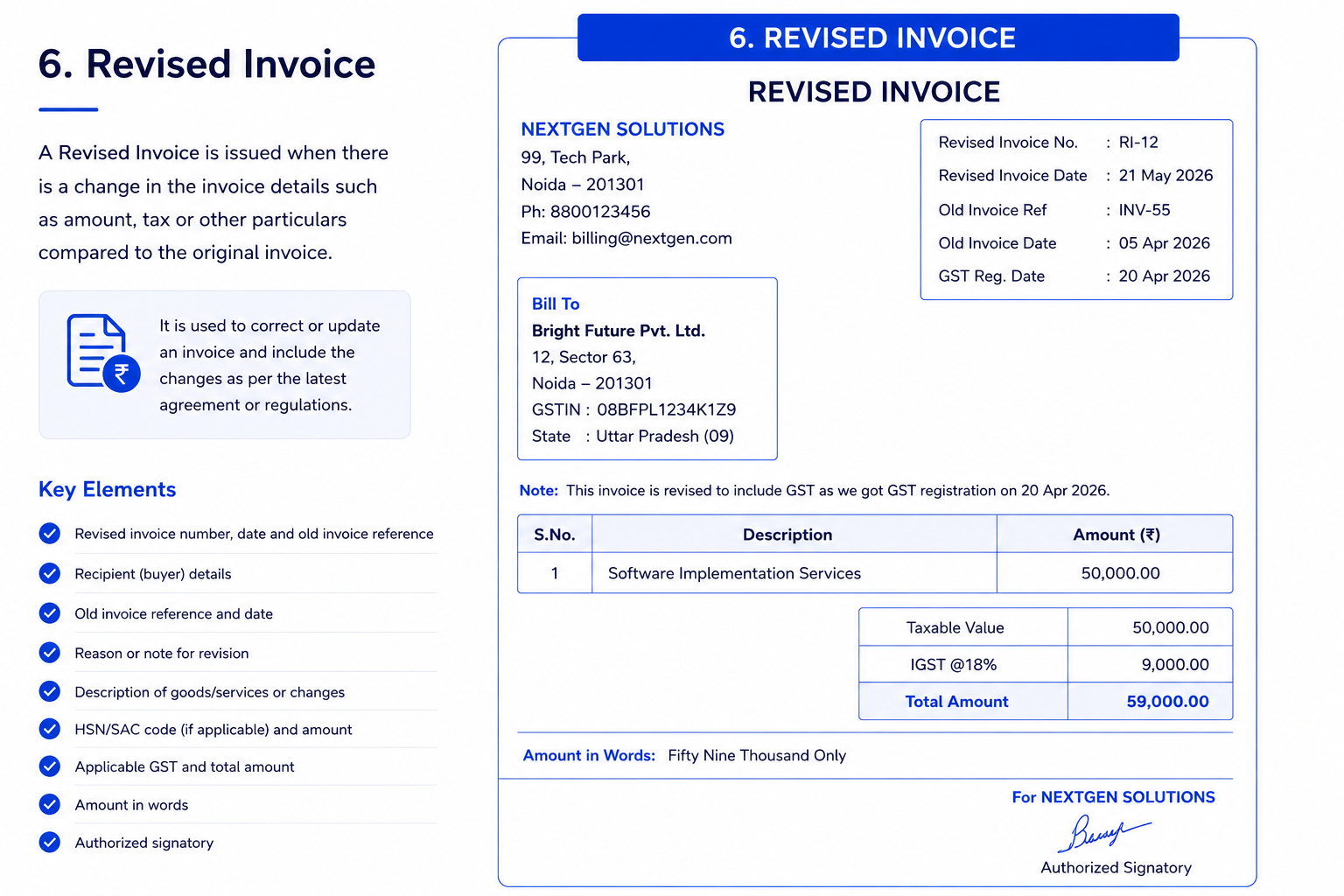
Example
Let us suppose that a business becomes liable to collect GST from 1st April and gets its GST registration certificate only on 20th April. In such a scenario, revised invoices can be issued for supplies made within this interim period.
Receipt Voucher
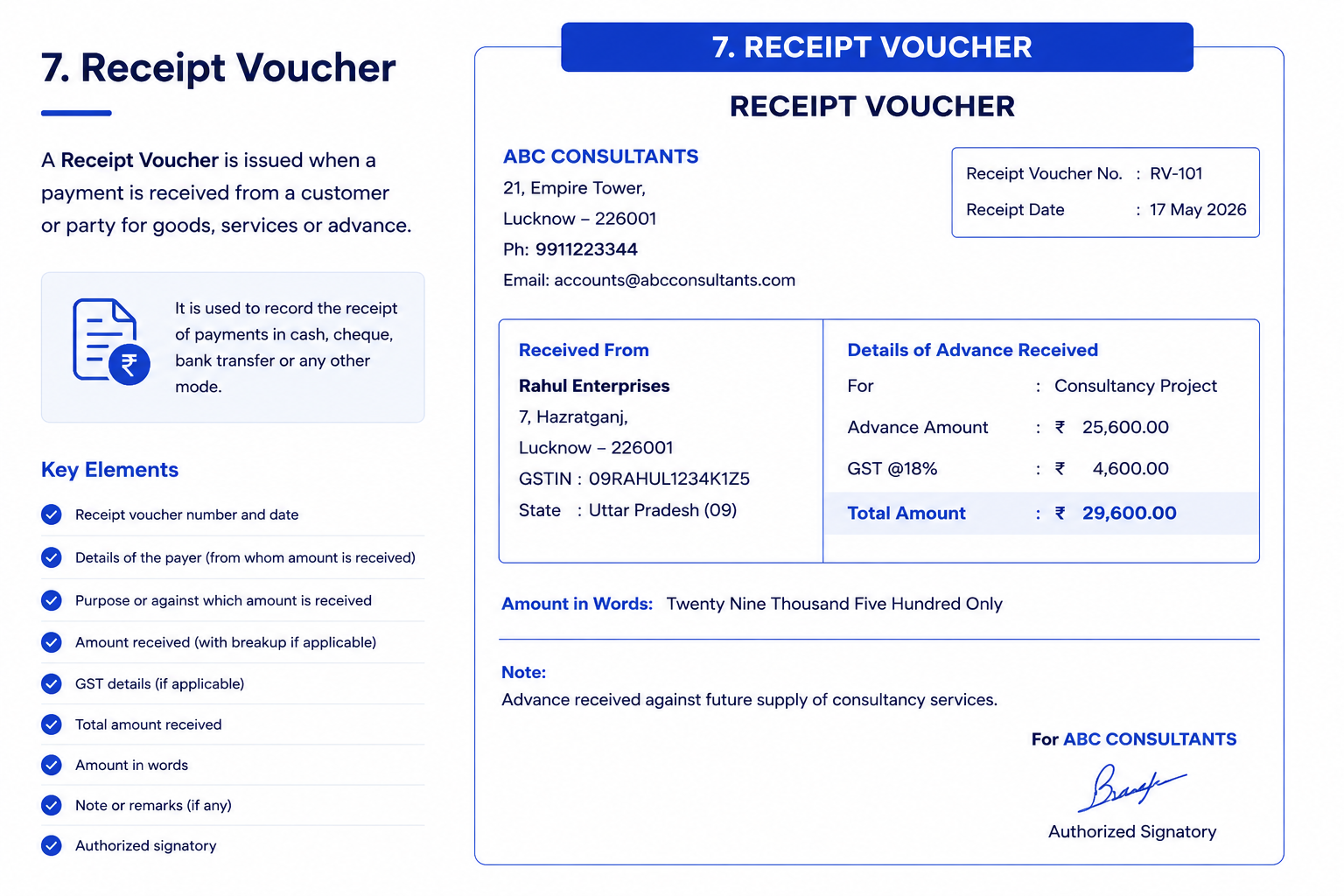
Receipt vouchers are issued when the advance amount is received prior to making the supply.
Why it is Importance
Under GST law provisions, advance payments need to be documented.
Example
A customer pays in advance for a consultancy job which is to be performed in the coming month. A receipt voucher is raised in respect of payment of the advance made by the customer.
This type of document is required to keep accounting and auditing records.
Refund Voucher
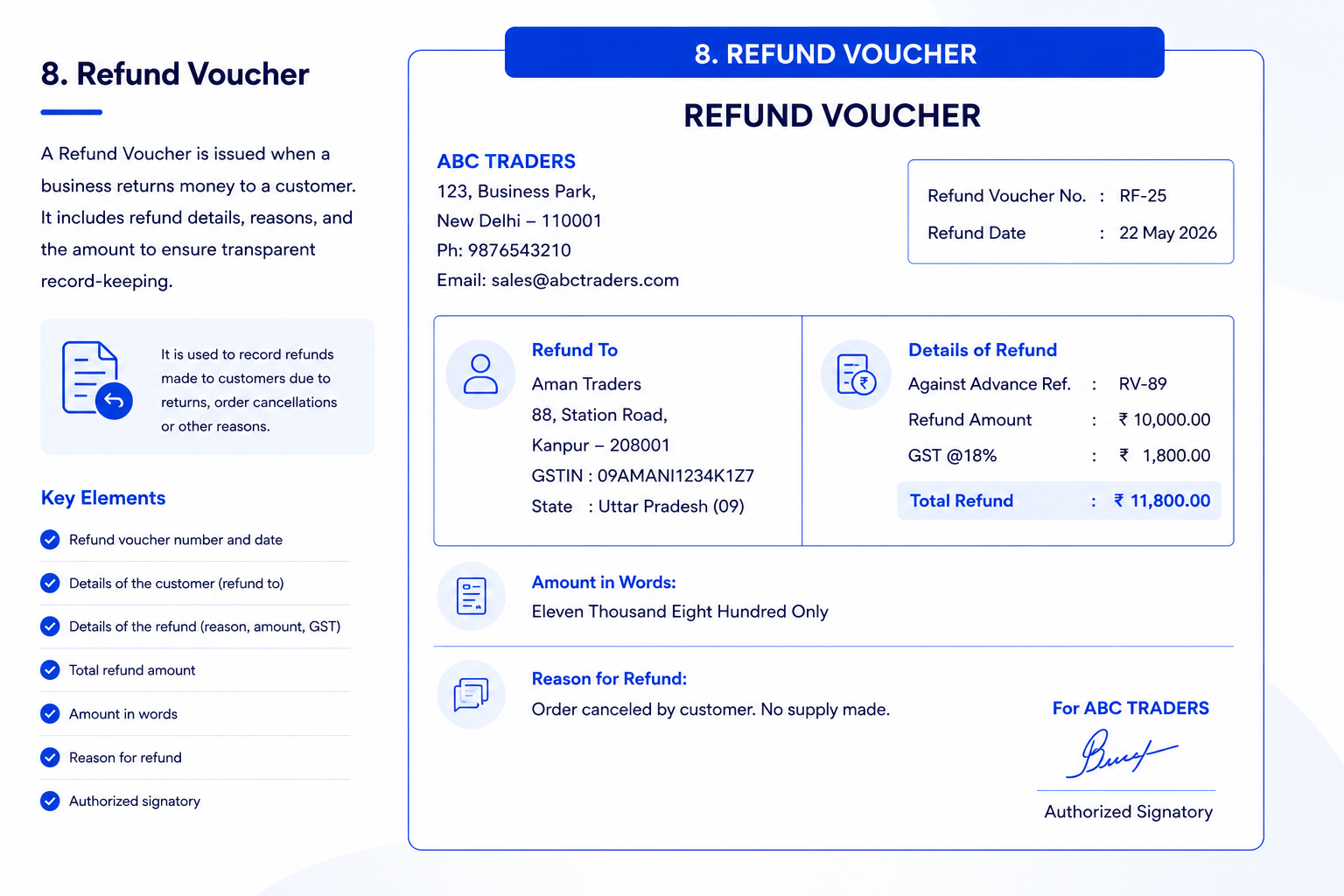
In case of a refund of advance money received earlier, the refund voucher is raised since there will be no supply.
Example
In case a customer has paid in advance for an order but the same is cancelled, a refund of the advance is made by the supplier and a refund voucher is raised.
This will help to keep the record of transactions in proper order.
Tax Invoice vs Bill of Supply: Differences Explained at a Glance
| Point of comparison | Tax Invoice | Bill of Supply |
|---|---|---|
| GST charged | Applicable | Not Applicable |
| Applicable for | Regular GST taxpayer | Composition dealers, Unregister dealers |
| Tax amount shown | Yes | No |
| Input tax credit available | Yes | No |
| Issued By | Regular GST taxpayers | Composition dealers, exempt suppliers, and some unregistered dealers in specific cases |
| GSTIN Mentioned | Mandatory if registered | Mentioned if composition dealer is registered |
| Eligibility to Claim ITC | Buyer can claim ITC based on tax invoice | ITC cannot be claimed |
| Invoice Format | Includes CGST, SGST, or IGST details | Does not contain tax breakup |
| Reverse Charge Mention | Mentioned if applicable | Usually not applicable |
| Number of Copies Required | Generally 3 copies for goods and 2 for services | Similar business copy structure but without tax details |
| Suitable Businesses | Manufacturers, wholesalers, retailers, service providers | Small businesses under composition scheme, exempt suppliers |
| Example | Electronics store selling taxable products | Small stationery shop under composition scheme |
These points of difference have been mentioned for a clear understanding of the invoice.
Details to be Mentioned in a Tax Invoice
Since the tax invoice is the most widely used invoice form, business organisations should ensure that their tax invoice contains the following mandatory information.
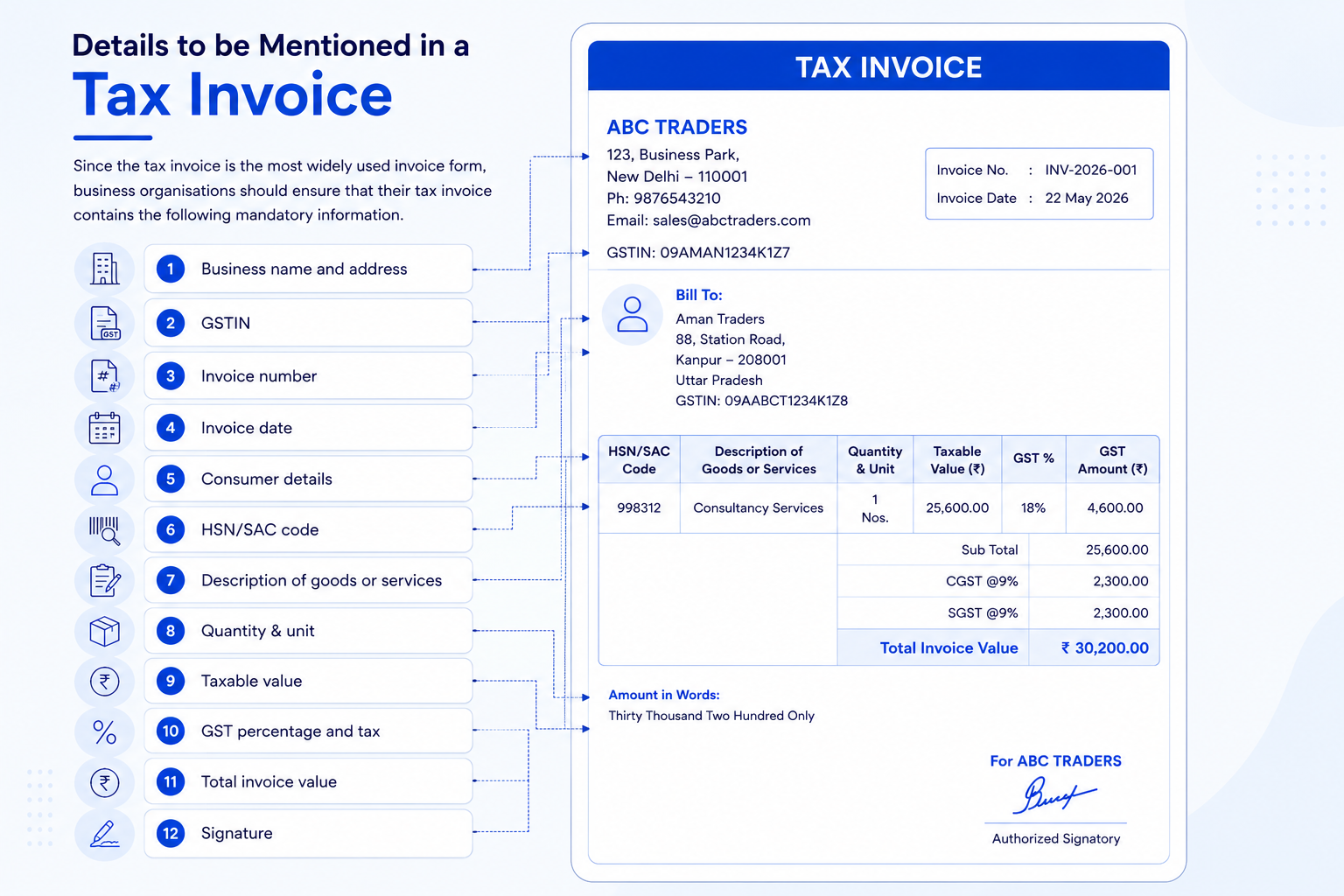
Business name and address
GSTIN
Invoice number
Invoice date
Consumer details
HSN/SAC code
Description of goods or services
Quantity & unit
Taxable value
GST percentage and tax
Total invoice value
Signature
The absence of all of these may cause compliance problems in the future.
Invoice Errors that Businesses Must Avoid
Although seasoned businesses sometimes fall prey to certain pitfalls, the following are some common invoice mistakes:
Choosing the incorrect invoice type
Using a tax invoice instead of a bill of supply can be problematic while claiming input tax credits.
Inaccurate GST information
Wrong GSTIN, tax rate, or no HSN code can result in input tax credit claims being rejected.
Try Our Free HSN Code & GST Rate Finder Tool
Delayed invoice generation
The law clearly outlines deadlines for generating invoices in order to comply with GST requirements.
Manual errors in conventional invoicing system
Companies that still use tax invoice bill books can experience duplication, inaccurate number sequence, or incomplete entries.
While these mistakes might not appear problematic on the surface, they can cause huge discrepancies in the future.
Why Modern Businesses Are Moving Towards Automated GST Billing
The more elaborate the requirements get for invoices, the more companies tend to move away from manual invoices to automated invoicing solutions.
Advantages of automated invoicing software include the following capabilities for companies:
Choosing right invoice templates
Accurately calculating GST
Avoiding invoice number duplications
Storing all information digitally
Facilitating return filing procedures
Ensuring proper compliance in invoices
Therefore, for Indian companies dealing with a significant number of invoices, invoice automation can be extremely useful.
To wrap up
Invoicing under GST is much more than just writing up an invoice. Invoices are issued by businesses for a certain type of transaction only.
Be it a tax invoice bill, bill of supply, debit note, credit note, or supplementary invoice ΓÇô there are several different document types to choose from.
It is essential for Indian companies to know the nuances of each type of invoice, as this will ensure effective operation.
By learning how to correctly issue an invoice using either a manual tax invoice bill book or software, you will save yourself a lot of trouble in the future.
Related Articles:
Purchase Order vs Invoice: Key Differences, Examples & When to Use Each

About Praneeth Gudivada
Ready to automate your billing and collections?
Join thousands of smart businesses using Pilloo to create invoices via voice and recover payments on autopilot.