
Purchase Order vs Invoice: Key Differences, Examples & When to Use Each
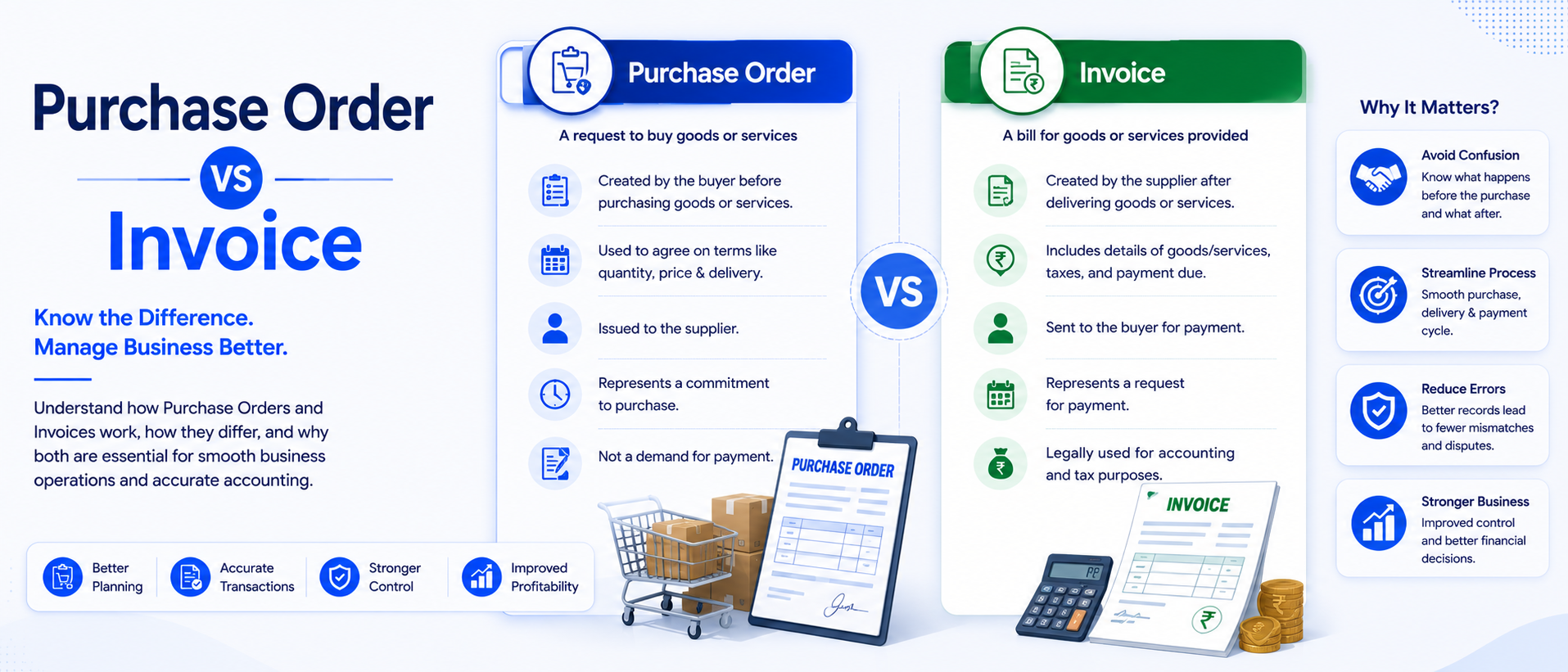
Purchase Order vs Invoice: Key Differences, Examples & When to Use Each
No business transaction can ever be complete without the presence of documents. For consistency in the records as well as to prevent any misunderstandings in the future, the use of structured documents such as purchase orders and invoices becomes imperative because they help record information consistently without any errors.
Yet there exists confusion among most businessmen and even newbies to accounts on the differences that exist between a purchase order and an invoice.
It is important to have an idea about the difference that exists between the two terms, which will enable one to keep track of their business and maintain accurate cash flow. This article is going to explore more details about the difference between a purchase order and an invoice.
What is a Purchase Order?
A Purchase Order (PO) is a formal document from the buyer to the seller that indicates the willingness to buy goods and services. Thus, PO is the most important request and contains the entire details of a transaction.
Main Elements of Purchase Orders:
Names of the seller and buyer
Goods/services description
Price and quantity
Delivery period
Terms of payment
Purchase order number (identifier)
Full Form of Po in Invoice Meaning
The Po meaning in the invoice context is Purchase Order. Even though this type of document is not related directly to an invoice, it can be used for further identification.
To get a clear insight into different formats of Purchase Orders under different circumstances, take a look at these examples:
Standard Purchase Order
A retailer sends a standard purchase order to a vendor to purchase 100 pieces of goods at ₹500 per piece. Delivery needs to be made within 10 days.
Blanket Purchase Order
A company generates a blanket purchase order for office stationery not exceeding ₹50,000 for 6 months from the current date. Purchases are made whenever needed without creating fresh purchase orders.
Planned Purchase Order
A manufacturer makes a planned purchase order for 1000 units of raw material. The deliveries are to be made in batches of 3 months. The precise delivery date might not be determined.
Contract Purchase Order
An enterprise generates a contract purchase order agreement with a supplier on future purchases with specific terms and conditions but no delivery details and quantities mentioned.
Understanding An Invoice
The definition of an invoice refers to a document generated by the seller after the delivery of the goods/services. It is a demand for payment with the full information about the transaction.
Main Elements of an Invoice:
Details about the seller and buyer
Invoice number
Description of the sold item
Quantity and total price
GST Details (included when applicableΓÇömandatory for GST-registered businesses and taxable supplies; not required for unregistered sellers or exempt goods/services)
Date of payment
Usually, when people talk about po invoice, they mean the invoice that has a PO number.
Also Read: What Is Invoice Automation and How Does It Work?
Purchase Order vs Invoice: Key Differences
Understanding the purchase order vs invoice comparison becomes easier when viewed in a structured format. Here is a detailed table highlighting the differences:
This clearly explains the difference between a purchase order and an invoice and helps businesses avoid confusion.
Invoice Order Meaning Explained
The confusion about the invoice order meaning might be due to the fact that the invoice order usually refers to the relation between the order and the invoice.
In simple words:
Order comes first (purchase order made)
Invoice comes second (payment required)
This process enables adequate paperwork and eliminates potential conflicts between the buyer and the seller.
What Is a Purchase Invoice Number?
Another issue that concerns accountants and business owners is what is a purchase invoice number?
A purchase invoice number is a special number that allows identifying each invoice issued by a supplier or vendor to a buyer. This number helps in:
Tracking expenses
Keeping records
Avoiding double payments
Bookkeeping
The use of such a number also helps in GST filing.
When to Use a Purchase Order?
The usual time when purchase orders should be sent to suppliers is before making payment or receiving goods. Purchase orders are crucial for organizations that:
Have large or bulk orders;
Need approval for buying any products or services;
Wish to keep record of their procurements;
Do not want to have conflicts with suppliers;
Use of Purchase Orders
Makes process transparent
Assists in managing budgets;
Prevents any unauthorized purchase;
Creates contract between buyer and seller
Conditions Where Purchase Orders Are Not Appropriate
Purchase orders come in handy at many times, but not all situations require you to issue one. Some cases include:
Small-value purchases
When making small-scale purchases (for instance, snacks for your office or small office items), a purchase order is too much
Instant and cash-based purchases
When purchasing an item instantly (for example, buying a product in a shopping mall), purchase orders or invoice would do fine
Recurring or subscription services
Where you have to pay monthly bills such as internet, electricity charges, software subscriptions, etc.
Contractual agreement
When there is a pre-existing contract in which prices and other details are agreed on beforehand, the use of a purchase order may be irrelevant.
Emergency purchases
In the event of emergency purchases, a purchase order may take unnecessary time to be completed.
When to Use an Invoice?
Invoices are issued when the products or services are already provided. Some of its uses include:
Demand for payment
Sales accounting
Accounting
GST filing
Advantages of Using Invoices:
Guarantees prompt payment
Functions as evidence of transaction
Facilitates tax filing
Aids financial statement preparation
Example Scenario: Purchase Order vs. Invoice
We will now learn about the purchase order vs. invoice using a simple scenario:
The need for office equipment arises in a firm.
The firm issues a purchase order for these products from the seller.
The seller approves and delivers the merchandise.
The seller issues an invoice post-delivery.
The firm cross-checks the invoice with the purchase order and pays the bill.
Thus, using invoices and purchase orders guarantees proper delivery and transactions.
Also Read: How to Reduce Manual Invoice Processing in Growing Businesses
Why is is important to Match PO and Invoice
The matching of purchase orders and invoices is a critical task in accounting, and it is called three-way matching, which consists of
Purchase Order
Goods Received
Invoices
Some of its benefits include:
Matching the right quantity of goods received
Ensuring the accurate price
Avoiding double entries
Automated solutions can make this job easy. Not reconciling the PO and the invoices could cause monetary problems, auditing problems, double payment, or even payment for something that was not received and, in some cases, could lead to legal consequences.
Use of AI in Management of Purchase Orders and Invoices
There is increasing adoption of automation in business, and solutions like Pilloo AI provide efficient solutions for management of invoices and purchase orders.
By using an effective solution, businesses can enjoy:
Automated invoice creation
Data extraction from purchase orders
Matching invoices and POs
Eliminating errors
GST compliance
These features are helpful for businesses seeking to use GST compliant accounting software.
Common Mistakes to Avoid
When dealing with purchase orders and invoices, some common mistakes that companies make include:
Mixing up the terms PO and invoice
Not using PO numbers in invoices
Lack of critical information
Incorrect tax computation
Bad accounting practices
Learning how to avoid such issues will help achieve accurate accounting.
Best Practices for Companies
To ensure proper management of the distinction between purchase order and invoice, companies should
Always have a purchase order before purchasing anything
Have the right PO number reflected on invoices
Keep proper documents
Automate their purchase orders
Do reconciliations frequently
To wrap up
An insight into the Purchase Order vs. Invoice notion is vital for any organization engaged in purchasing and selling. Even though a purchase order starts a process, an invoice finishes it by requiring payment.
Being aware of the distinction between purchase order and invoice is crucial for organizations to be able to operate smoothly and effectively without any controversies or issues. Regardless of whether you run a small company or a big corporation, applying appropriate procedures can be very helpful.
Thanks to current technology, such as artificial intelligence-driven accounting software, it is now easy and fast to deal with both purchase orders and invoices.
Ready to automate your billing and collections?
Join thousands of smart businesses using Pilloo to create invoices via voice and recover payments on autopilot.