
What Is SAC Code in GST? Meaning, Full Form & Uses
What Is SAC Code in GST? Meaning, Full Form & Uses
The first step towards understanding any regulation is becoming familiar with its terminologies. As far as India's GST Act is concerned, those involved in trading physical goods are aware of the Harmonized System of Nomenclature (HSN) code. But if your business activity includes the offering of services such as software development, consultancy, hospitality, logistics, or freelancing services, then the SAC code holds importance.
Using an incorrect classification of services may result in rejection of tax filing, miscalculations, or even sudden audits by the authorities. Here is a guide for you that explains what is sac code in gst and everything else you need to know.
Introduction ΓÇô Definition of Basics: What is SAC Code?
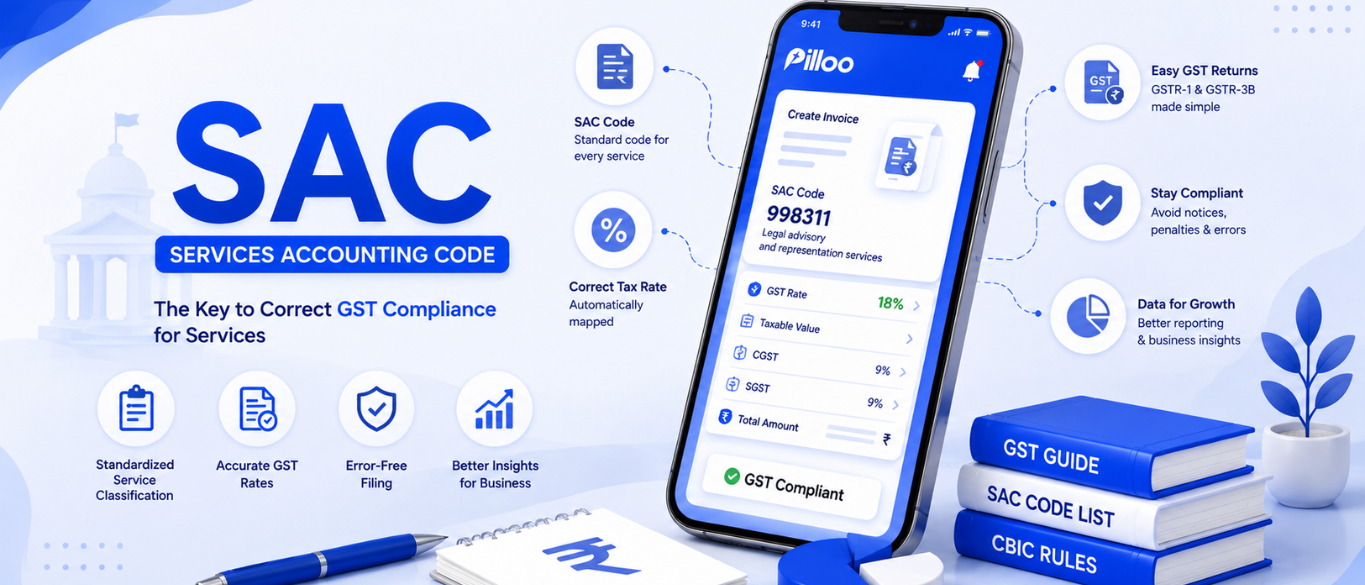
Sac code full form is the acronym of the term Services Accounting Code. It is a standard nomenclature system that has been used by the Central Board of Indirect Taxes and Customs (CBIC).
Though, SAC full form in general terms implies the term Services Accounting Code; it works on the basis of a system carried forward from the erstwhile regime of Service Tax in India. Post the landmark launch of a new GST regime in the country on July 1, 2017, the government in India decided to continue with this proven system.
Strategic Importance: What Is SAC Code in GST?
Use of standardized numerics resolves a colossal issue in administration. Given the huge size of the country, description of service varies greatly across states. If a firm calls an assignment "Software Application Development" while another describes their service as "Cloud Architecture Provisioning," then manual analysis becomes quite impossible. It will take years and cost lots of money to analyze millions of records and calculate tax rates or track economic trends.
With two firms using identical codes, however, data is immediately standardized and ready for further processing. This approach has a number of advantages:
Automated Tax Rate Assignment: The GST portal assigns particular tax rates to certain numbers of SAC (5%, 12%, 18%, or 28%). As soon as you enter your code on a website, it assigns the corresponding rate automatically.
Easier GSTR-1 & GSTR-3B Filling: With modern GST reports requiring classification codes to produce summary statements, you make sure that your customer gets ITC right according to your supplies.
Macro-analysis: Data anonymized and grouped based on SAC numbers is used by the Ministry of Finance to decide on fiscal policies and identify growing sectors.
Deconstructing the Structure: How a SAC Code is Organized
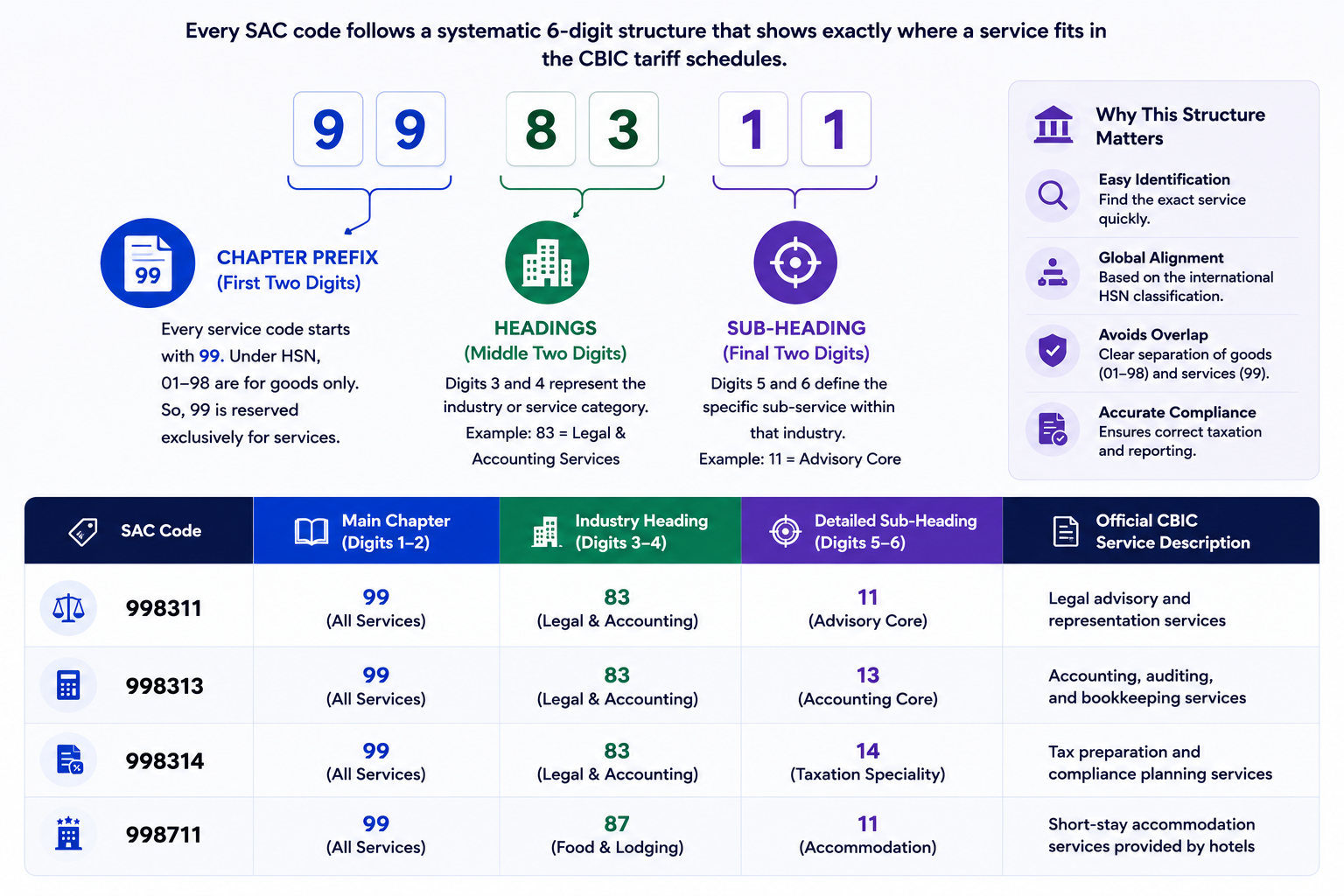
Every valid SAC code possesses a systematic hierarchy, expressed in numerals. With a careful analysis of the individual two digit pairs, one can easily establish where an individual service is placed according to the CBIC tariff schedules.
Most SAC codes are six digits in length, beginning with the same four digits ΓÇô the universal prefix code 99.
Chapter Prefix (First Two Digits)
Every service ledger code starts with the digits 99. Under the internationally recognized classification method of the Harmonized System Nomenclature (HSN), the chapter prefixes 01 to 98 refer only to material products. Since any overlapping would be avoided, the Indian Taxation System allocated the chapter prefix 99 for services only.
Headings (Middle Two Digits)
The three and fourth digits are meant to signify the particular industry type. As an example, the digits 83 indicate the Legal and Accounting Services industry, whereas 87 stands for Lodging, Food, and Beverage Services.
The Sub-Heading (Final Two Digits)
The last two digits identify the very precise sub-service provided. These digits single out an action carried out in a particular industrial sector.
For purposes of illustration of how this classification system works, letΓÇÖs look at a structural analysis of various types of businesses:
HSN Code VS SAC Code: Understanding the Major Differences Between Both
When it comes to new businessmen or start-up companies, they can often find it difficult to know which between the two HSN code and SAC code for gst should be used. Although both codes are designed to standardize the tax information, they apply to different aspects of business entirely.
ItΓÇÖs vital to recognize these dissimilarities for the creation of efficient billing invoices and systems:
Practical Uses: Where Do We See the Use of SAC Codes?
The application of SAC codes does not end at just a page in the manual by the government on taxes. The SAC code has to be used actively as it is related directly to the daily workings of the company, finances, and accounting.
Compulsory Fields on Tax Invoices
According to Section 31 of CGST Act, issuing a tax invoice necessitates providing compulsory details in certain fields in that particular tax invoice. If you run a business offering services, then according to the law, it is required to put down the 6-digit SAC code beside the description of all service items in the invoice. Non-compliance with this will make the invoice void, making the claim of Input Tax Credit (ITC) by your B2B clients impossible.
GST Registration Process
While registering your GSTIN number, you have to declare your principal and secondary activities. As a service provider, you are required to choose SAC codes while registering.
Implementation of Reverse Charge Mechanism (RCM) Workflows
Where a particular type of service contract exists like employing commercial goods transport agencies (GTA), purchasing legal services through an individual advocate, or organizing public functions, the responsibility for payment of GST falls on the person receiving rather than giving the service. Such an operation is referred to as Reverse Charge Mechanism (RCM).
Guidance and Rules: How Many Digits Should Be Reported?
The Indian government implements dynamic invoicing rules depending on how large a company is, thus making sure to accommodate both small and mid-level businesses.
The minimum number of digits required to be reported depends on the following criteria of total annual turnover in the last financial year (AATO):
Up to ₹5 Crore Turnover: In the case of smaller firms with annual turnover lower than this limit, disclosure of SAC codes on out invoices for business-to-business transactions may not be compulsory, although it is recommended to do so. In case of invoices for business-to-customer sales, no disclosure is required at all.
Above ₹5 Crore Turnover: For midsize and bigger companies that have achieved this landmark of annual turnover, it becomes compulsory to disclose their complete 6-digit SAC code.
SAC Code Step by Step Procedure: Finding Your Right SAC Code
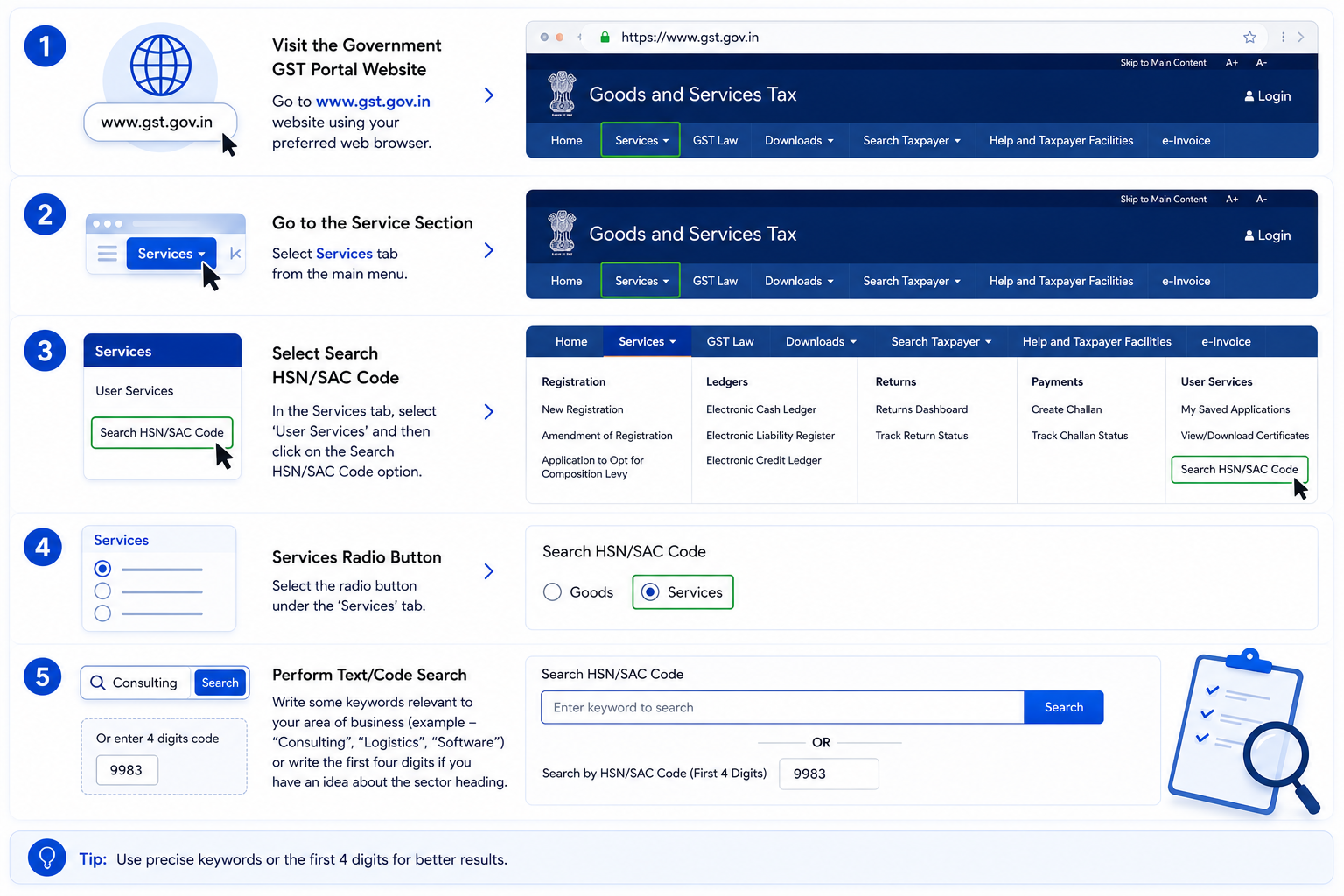
Finding your right SAC code among thousands of documents issued by the government can be very easy if done through the governmentΓÇÖs officially recommended process.
Visit the Government GST Portal Website: Go to www.gst.gov.in website using your preferred web browser.
Go to the Service Section: Select Services tab from the main menu.
Select Search HSN/SAC Code: In the Services tab, select ΓÇÿUser ServicesΓÇÖ and then click on the Search HSN/SAC Code option.
Services Radio Button: Select the radio button under the ΓÇÿServicesΓÇÖ tab.
Perform Text/Code Search: Write some keywords relevant to your area of business (example ΓÇô ΓÇ£ConsultingΓÇ¥, ΓÇ£LogisticsΓÇ¥, ΓÇ£SoftwareΓÇ¥) or write the first four digits if you have an idea about the sector heading.
Operational Risk ΓÇô What if Your Business Applies the Wrong Service Code?
Applying the wrong SAC code creates considerable problems from an operational standpoint. Modern day tax filings depend on automated audits based on cross-network operations.
Inconsistent Input Tax Credits
Issuing an invoice with an incorrect SAC code implies that there will be discrepancies in the customer's automated GSTR-2B statement. They may deny payment of invoices until they receive an official credit note and a revised invoice issued due to the incorrect SAC code being flagged by their internal auditing software.
Imposition of Additional Tax Liabilities
All services have different tax rates. If there is a misclassification of services where the tax rate is higher, it leads to an imposition of additional taxes. These can only be paid once audited based on section 50 of the CGST Act.
Fines For Invoicing Violations
Section 125 of the CGST Act states that making any mistake or leaving out information while preparing invoices could result in fines for up to ₹25,000 per instance. Maintaining your classification codes as up-to-date and precise as possible helps prevent such administrative fines easily.
Summary & Moving Forward
The sac code meaning is more than just a mundane checklist for compliance; it is the key coding system that turns your service business into automated accounting reports. Understanding and implementing what is sac code, knowing what sac code full form includes, and checking your codes on the official portal will keep your enterprise safe from compliance issues, secure tax refunds for your clients, and streamline your accounting practices.
FAQs
Q1. Are there any types of service provision within India that begin anything other than with the number 99?
No, within the framework of GST within India, all services fall under Chapter 99. The design ensures the distinction between the structure of the service tax from the structure of the HSN codes which are used only to identify physical goods using chapters 01-98.
Q2. What would I need to do if I provided a mixture of goods and services to a customer?
Such provision is defined in the CGST Act as either a composite or a mixed supply. Where the elements are bundled together naturally (such as selling a laptop with an extended warranty) then the SAC code used will be that for the primary item sold.
Q3. Do charitable organizations who provide services for free require SAC codes?
SAC codes relate to taxable services that have been provided in a business sense. Where a non-profit or other organization provides its services free of charge for purely charitable purposes and has no business purpose, it does not qualify as a taxable supply.

About Praneeth Gudivada
Ready to automate your billing and collections?
Join thousands of smart businesses using Pilloo to create invoices via voice and recover payments on autopilot.