
How to Maintain Billing Accuracy Without Double-Checking Everything?
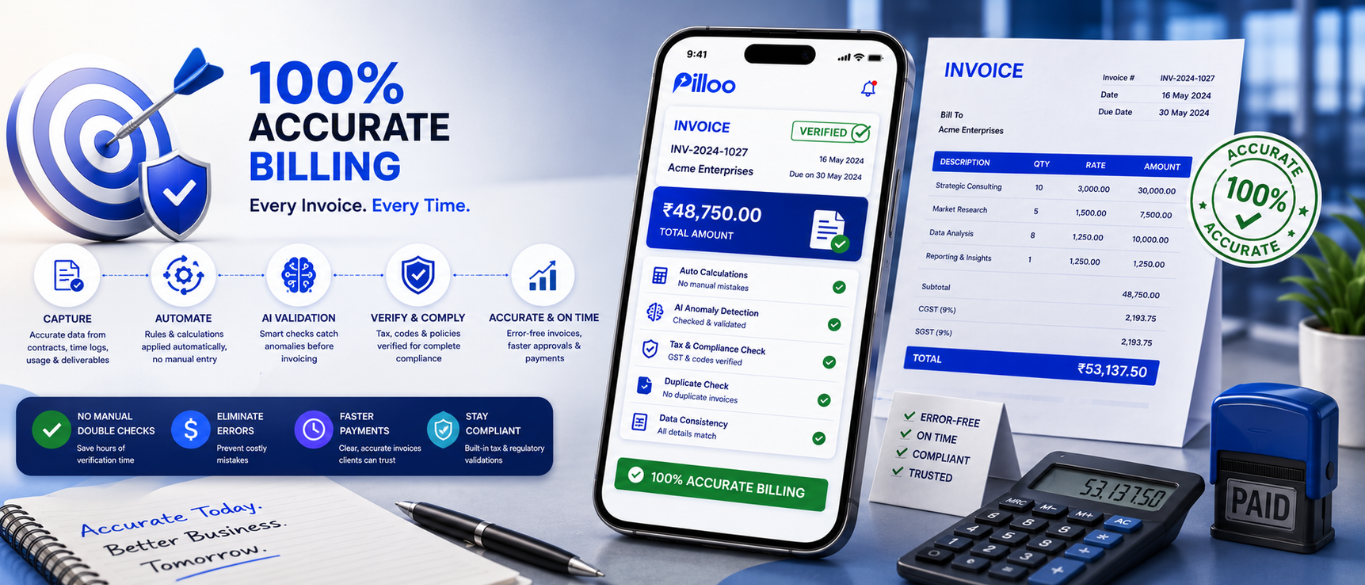
How to Maintain Billing Accuracy Without Double-Checking Everything?
In the perfect world, the completed invoice would be the epitome of a transaction flawlessly executed ΓÇô an absolutely accurate numerical breakdown of all services provided, expenses incurred, and agreements made. But for a rapidly expanding company, the true monthly routine ends up being somewhat of a real-life hunt.
It entails account managers spending time searching emails to make sure that there is no discrepancy in client retainers, while operations managers are busy matching time reports with contractual obligations. At the same time, the accounting department tries to spot an accidental zero in calculations to prevent the issue from showing up in the invoice.
However, this constant checking poses an operational challenge as well since it turns out that when the main tool you have to guarantee billing accuracy is the ability of people to check each invoice line-by-line, there is an obvious problem with scalability. It cannot be solved by increasing the number of managers or working overtime.
Get Rid of the Source Code of Errors: Contracting the Facts
It is very rare that the reason for errors in billing has anything to do with the poor math skills of your finance department. Errors usually occur because the source data on which the invoices were built is scattered among disparate applications.
Should the salesperson sign off on the customer on a special tier pricing plan, log it down in the local contract PDF file, and expect the billing team to figure out what exactly needs to be done according to the information stored in the CRM notes, there will always be an error somewhere in the process.
The Fix: Structural Parameterization
In order to ensure that hands-free processes work as intended, the contract terms have to be treated as structural parameters for the database, not narrative text.
Standardize Rate Schemas: Cluster your services output as predefined service catalog within your centralized platform.
Implement Automated Connections: Tie in your customer management platform with your accounting through an automated API. Whenever a contract amendment or activation occurs, relevant parameters such as the basic rates, volume increments, and billing cycles should be automatically mapped onto the invoice accuracyΓÇï schedule.
Programmable Price Tiers: If the client contract calls for automatic reductions in price once a certain threshold is reached, let the software track the progress and change the tier automatically.
Apply Artificial Intelligence to Predictive Anomaly Identification
The transition from human-based monitoring does not imply that the software used for billing should not be supervised. In reality, smart companies employ machine learning algorithms which work silently as gatekeepers.
The application of ai in billing and coding accuracyΓÇï has entirely changed the way the process of revenue cycle management takes place today. In this context, it is more efficient to let computers analyze past transactions than have a person check for mistakes across multiple pages of invoices.
Interception through Advanced Algorithmic Means
AI billings software runs continually beneath the surface, analyzing data on an unprecedented level to assess risk and intent:
Behavioral Profiling in Context: An AI guardrail will recognize an anomaly instantly when an established business account consistently bills between $4,500 and $5,200 and then receives an invoice marked up to $50,000 due to a manual entry error.
Validation of Automated Code and Classification: In environments where regulation is complicated, such as freight forwarders internationally and corporate legal counsel internally, a wrong tax code or misidentification of a service could easily incur penalties. AI software reads the raw conversational logs of services provided and assigns the correct regulatory codes with pinpoint accuracy.
Mitigation of Predicted Payment Disputes: Based on historical dispute trends or previous rejections, predictive analytics models evaluate outgoing bills to avoid potential payment issues, such as missing purchase orders, unapproved sign-offs, and even incomplete data fields.
High Stakes Benchmarks: Billing Accuracy in Financial Services
Where a billing inaccuracy can be annoying in a typical service industry setting, an error during the invoicing process in an enterprise asset management context, commercial bank environment, or in portfolio administration will immediately trigger regulatory sanctions.
Financial services billing accuracy involves the management of complex, multi-tiered variables that include dynamic asset valuation, multi-currency transactions, performance fee changes, and jurisdictional taxation requirements at any one point in time.
Case Study: Revenue Cycle Scaling Safely
A mid-tier investment advisory firm managing more than $1.2B through 450 unique high net worth client portfolios previously spent three full-time staff members over four business days per quarter merely calculating and verifying their management fees.
This process involved the manual gathering of weighted average asset valuations at differing time periods, drawn from different custodian portals, with a specific fee rate applied based on custom spreadsheet-based tiers.
Through switching to an automated system of billings with live custodian feed inputs and calculations based on parameters, the firm revolutionized its procedure:
Verification work hours were reduced dramatically from 96 hours to just under 45 minutes for exceptions only.
Calculation accuracy of billings hit a definite 99.98%, thus eradicating all chances of human error in typing and classifying portfolios.
Leakage in quarterly revenue was halted, and $42,000 in performance tier fees went uncaptured in the very first cycle of use.
Design Intuitive Feedback Loops to Improve Client Billing Accuracy
Automation takes care of all the hard work, but the last piece of making sure that your invoices get billed perfectly without requiring any intervention is optimizing the way you communicate financially with your clients.
Generic line items like "Professional Consulting Services ΓÇô 12 Hours" prompt automatic questions and reviews, slowing down the process of payment even further. Without sufficient context being provided within your invoices, you will make your clients go through the manual audit process.
This increases the amount of friction and causes your DSO figures to inflate.
Billing Accuracy Architecture
Enforced Itemization: Avoid using broad categorizations; instead, include detailed and timestamped activity logs and specific deliverables that are pulled directly from production streams.
Integrated Interactive Data Links: Provide clients with quick access to all data support without having to look through the invoice itself by including links to validated time sheets, usage metrics, and milestones completed for instant verification on delivery.
Native Compliance Validation: Include on the invoice accuracyΓÇï metadata about the transaction such as purchase order numbers, firm identification, and branch identification to circumvent routing delays at the client end.
Comparing Financial Services Billing Accuracy: Manual Verification vs. Systemic Automation
The Roadmap to Building a Touchless Invoicing Infrastructure
Definite billing accuracy without the need for tedious manual checks is achievable. This involves shifting your mindset from one of reactive monitoring and toward a proactive approach of creating an integrated, dependable data infrastructure.
By defining your parameters within your customer contracts upfront, integrating your core business systems through clean APIs, and leveraging smart AI-powered guardrails to detect anomalies, you create a self-correcting invoicing system. You will be relieved of manual work, eliminate revenue leaks, and ensure your customers receive invoices they can easily pay right away.
FAQs
Q1. How do automated invoicing programs prevent repeat transactions and double charges?
Through the application of cryptography, metadata searching, and strict pattern recognition techniques, such programs will scan each field in the input data. The program compares the invoice numbers, exact amounts, purchase order numbers, and issue dates with past data.
Q2. Are artificial intelligence-based solutions sufficiently secure to store private company information?
Certainly. Contemporary business invoicing systems make use of localized machine learning models deployed inside highly secure cloud environments, adhering to internationally accepted security criteria, including SOC 2 Type II, GDPR, and ASC 606 regulatory systems.
Q3. How does an exception-based billing process work?
Exception-based billing involves using automation programs to handle most standard-compliant invoices autonomously without requiring any human involvement. Human accountants only intervene when an automatic guard rail trips due to a discrepancy, missing information, or invalid tax ID of the customer.

About Praneeth Gudivada
Ready to automate your billing and collections?
Join thousands of smart businesses using Pilloo to create invoices via voice and recover payments on autopilot.